Ethel Cook’s Pecan Pie

I have been asked for this recipe so many times, I can’t count. Here it is, my Grandma Ethel’s Pecan Pie. As a child, I could not get enough of this pie, and I really do think that my grandma’s recipe is the best. Sweet, and rich, but not overpowering.

It is easy to make, and only needs tender loving care to produce the best pie you’ve ever tasted. I believe the key to this pie is the combination of light and dark brown sugar. It creates a true Southern classic.
This recipe makes enough for 2- 9″ regular pies:

Ingredients:

2 9″ regular uncooked Pie shells, not deep dish.
2 cups of chopped Pecans
1 1/2 cups of Light Corn Syrup (Karo is my favorite)
3/4 cup of Light Brown Sugar
3/4 cup of Dark Brown Sugar
5 Eggs
1 stick of melted Butter
2 tsp. Vanilla Extract
Pinch of Salt
Preparation:
Preheat the oven to 350 degrees. Roast the pecans for a few minutes, watching them closely so they don’t burn. Remove the pecans and increase the heat to 400 degrees.
Beat the eggs, and mix together with, corn syrup, light and dark sugar, vanilla and a pinch of salt. Add in the melted butter and mix thoroughly. Place 1/2 of the pecans into the bottom of the pie shells.
Pour the filling into the 2 uncooked pie shells; sprinkle the rest of the pecans on top. Carefully place on the middle rack of the oven. Cook for 10 minutes at 400, and then reduce heat to 350 degrees and continue cooking for 35 to 45 min. until golden brown.
Allow to cool thoroughly before serving. They may be made the day before.

Seafood Stock – Perfect for Asian soups and seafood risotto.

This is a wonderful stock for any sort of Southeast Asian cuisine and certainly any seafood dish. It is also a wonderful stock for a seafood risotto.
Ingredients:
1 lb of Shrimp, shelled and shrimp set aside
1 or 2 whole Crabs, crab claws, crayfish
2 medium Onions, roughly chopped
10 Black Peppercorns
1 Lemon, juiced and then put into pot
1 tsp Salt
Preparation:
Start off by adding 1 Tbsp of vegetable oil to your wok or pan, and stir frying the crab and shrimp shells until they turn color. Then add all ingredients into the pot, cover with water bring to a boil and simmer uncovered for at least 2 hours. Strain and use as needed.
If you want to make an Asian soup stock or stock for SE Asian cooking, include the following ingredients.
1 Clove Garlic, cut in half
2 inch Ginger Root, cut into 4 pieces
2 Kaffir Lime Leaves – Optional, but essential if you are going to make Thai or Vietnamese soup dishes.
1 whole Star Anise

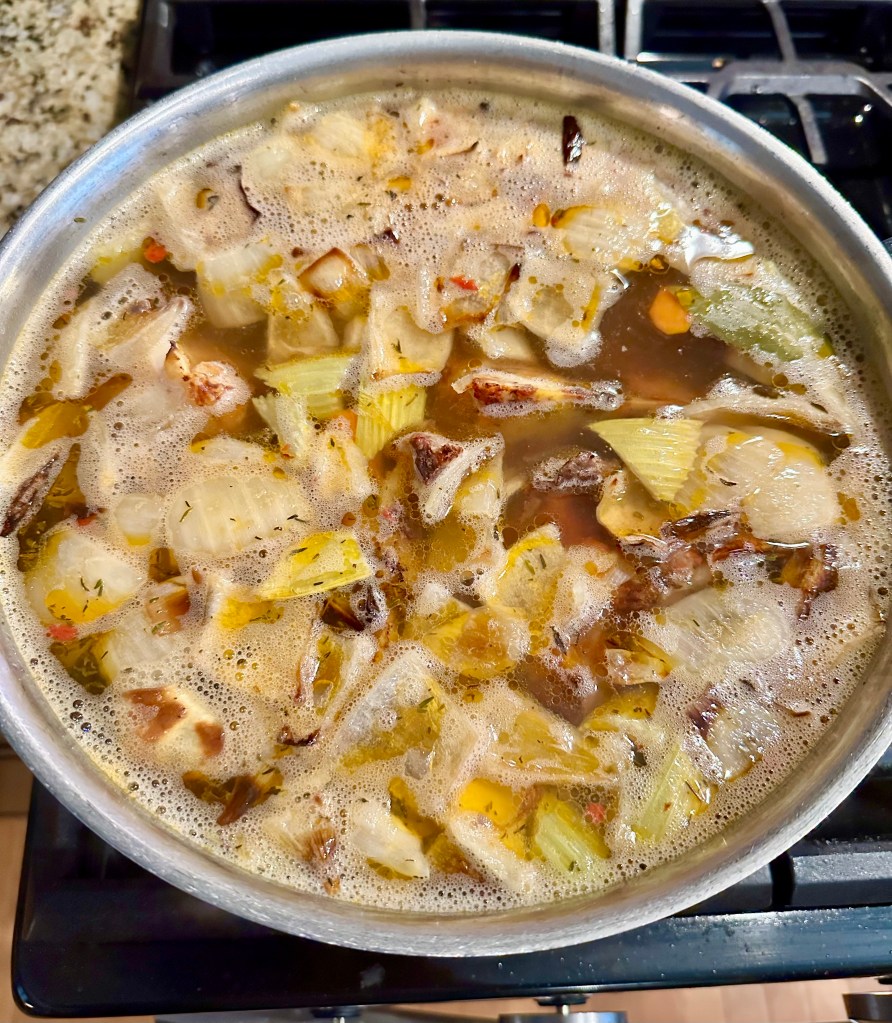
Homemade Beef Stock

Beef stock requires a bit more time, but the results are vastly superior to most of the prepared stocks I’ve seen in markets. I always have some chicken and beef stock on hand. Usually I just freeze it.


Ingredients:

5 – 7 pounds of Beef bones, try and include some marrow bones.
2 Carrots, roughly chopped
4 Celery stalks, leaves and all, roughly chopped
3 Medium onions cut in halves
1 Turnip, cut in half
2 Bay Leaves
10 Black Peppercorns
2 Tbsp Tomato Paste
1 tsp Sea Salt
 
Preparation:
 
Brush the beef bones with tomato paste and put onto a baking sheet and bake in a 350 degree oven until they are dark golden brown. This may take up to two hours, then add all ingredients into the stock pot and add enough water to cover. Bring to a boil and then gently simmer for 2-3 hours, adding water if need be. While simmering, strain off any scum that comes to the surface.

After allowing the stock to cool, remove any excess fat that’s solidfied, strain it and then cool thoroughly before either freezing or refrigerating in a covered storage container.
 

Selecting Your Basic Kitchen Tools

Pots and Pans– Here are a few general considerations when considering your pans;
  1. Can they go from stove top to oven? If they can’t this will greatly limit their use.
  2. Are they well made and will they distribute heat evenly. Quality pots and pans make cooking much easier. It’s very tough to make a great sauce or stunning stew in a thin grade aluminum pan.
Cast Iron Pots– I can’t say enough about the importance of using heavy duty pots, as they distribute heat well and will give vastly superior results. The initial investment is a bit more, but they last a lifetime. Some top brands are Le Creuset and Staub.
Large Non Stick Sauté Pan– This is a must in any kitchen for omelets, quick sautéing and seem to last best when hand washed and put up after use. I have had the best results with All Clad stainless non stick.
Wok– I find that unless you have a dedicated wok burner on your range, it’s quite difficult to manage the traditional style, so I prefer the ones with handles. Not fully authentic, but the results are what counts, and they are starting to catch on throughout Asia.
Tongs– These are staple in any professional kitchen and for good reason. They are versatile, fast and efficient. A few sizes will be very helpful.
Knives – This should be one of your best and first  investments. Just remember that sharp knives cut far fewer people than dull ones, as dull knives will slip. I use Wusthof with wonderful results.
Cutting Board – Plastic and wooden only. No glass or hard surfaces, or your lovely knives will be dulled within minutes. The key thing to remember is to try and have a surface that can be cleaned properly and if possible to use one board for meats and one for vegetables and other non meat products.
Sieves– I find so many uses for my small and medium size sieves, that I can’t imagine cooking without them. You may also use professional china caps, but some small simple sieves are indispensable.
Potato Ricer– If you want the fluffiest mashed potatoes, this is the way to go. It is also a great way to mash parsnips and other vegetables.
Wooden Spoons– I treasure my wooden spoons, as they become more comfortable with age. I find that the most basic are best. They do not need to be expensive. I few sizes are very helpful.
Spatulas – I cannot say enough about how handy these are. I actually have given them to people as a holiday gift and they have told me it is their favorite kitchen tool. Buy a few sizes and make sure you have one, which is extra small to get into the small dishes, ramekins and food processors.
Metal Measuring Spoons– Spend the extra money and go for these, as the plastic ones are just not worth it. Have two sets, so you won’t need to be washing in between use.
Measuring Cups– I find that a medium and then a large size is most efficient, and best if they can be made of Pyrex and can handle high heat. For baking the metal measuring cups with handles are the best.
Scale – A small kitchen scale is essential. Many people use them for weighing out ingredients when baking, however if you want a basic every day scale, it should be able to measure smaller quantities.

Thoughts on selecting the best ingredients.

The key to your success in the kitchen will be the quality of your ingredients. Yes, technique and preparation are important, but frankly the single most important factor is your produce, spices and pantry items.
Some items lend themselves to being stored and some do not. When in doubt, fresh is always best and buy the best you can afford.
There may not be a huge difference between a $20.00 bottle of extra virgin olive oil and a $30.00 bottle of extra virgin olive oil, but you can be assured there’s a difference with the $5.00 bottle.
Should you need an ingredient that is not found at your local market, there are many online sources.
Meat and Vegetables – I am a firm believer in supporting our local farmers. As a way to reduce your carbon footprint, this benefits us all and you get a few extra advantages.
Firstly, the produce is fresh, as it hasn’t had to come from half way around the world. Secondly, it is more likely to have been picked at it’s point of ripeness, as they know it will be in market within a day. Further, it’s often organic or at the very least, less processed.
Eggs– Free range and local farms only. Even better if you have the space, have a few hens of your own. Eggs do not need to be white, brown is beautiful too.
Cheeses– Again, buy locally whenever possible, buy frequently and try and get the best. If you want a special cheese that is made in a certain place, then search it out. If you want the best Parmesan, then go for Parmesano Reggiano; if you want Manchego, head to Spain. Buying cheap cheese is no bargain.
Butter – There are so many types of butter to choose from. If available, use a good local brand. If you have to use a major brand, chose the unsalted, as it has less shelf life and they need to rotate the stock. Margarine is not a butter substitute. In many ways it is potentially less healthy due to the hydrogenated fats, so enjoy your butter, but in moderation.
Stock– I enjoy making stock, so for me I always have some on hand. If it’s too much work for you, then choose one that is low in salt and organic. Remember that different stocks are used  differently, and a dish can be vastly improved by using the right stock or ruined by using the wrong stock. The basic stocks are Chicken, Beef, Veal, Seafood and Vegetable.
Pasta– For dried pasta I prefer the Italian brand DeCecco or Martelli. However, there are many artisan brands which are brilliant. Normally I find that the Italian brands are vastly superior to domestic brands.
Rice– There are so many types, just focus on the authentic taste and the use and the choice will be clear. Easy cook rice has no place in my kitchen. For example, basmati might be lovely with a curry, but doesn’t quite work in a risotto, and Thai food begs for jasmine rice.
Olive Oil– Normally Extra Virgin (EVOO) is my preference, but this is when you are using the oil to impart a taste. If the goal is long cooking, sautéing or frying, normal olive oil is sufficient.
Vegetable Oil– Use cold pressed only and keep it in the refrigerator. Oil will go rancid when not kept cold and nut oils are the most sensitive. Buy in reasonable sizes and replace as needed. Rancid oil is not only unhealthy; it ruins the flavor of your food.
Salt– I use sea salt or kosher salt, as I find its flavor is more interesting and less bitter than normal table salt. Some even say it’s healthier.
Black Pepper– Freshly ground Black Pepper and I find Tellicherry or Kampot peppercorns are fantastic.
Vinegar– I always keep a few kinds in the pantry, Champagne, Cider, Sherry and Rice. They each are unique and add an interesting nuance to your cooking.
Wine – Sherry, Cognac, Marsala and Madeira are essential. For red and white wines, dispense with the cooking wines, which are packed with salt. If you wouldn’t drink them, then don’t cook with them.
Garlic– Use fresh garlic and avoid the chopped garlic in oil, unless you prepare it yourself and use it within the week.
Fresh Herbs– There are some good sources for dried herbs when fresh are not available, but when fresh are in season, you will never go wrong in choosing them.
Spices– Keep as many of your spices as possible in whole form, and grind them as you need them. I keep a special “spice only” coffee grinder that I use for this purpose. Ground spices go down hill quickly, so if they have not been used in 6 months, throw them out. Remember if you are going to use whole spices, they normally need to be roasted first, and roasting is better when they are whole and then you can grind them after they cool a bit.
Smoked Paprika– I have found so many uses for this wonderful spice. It comes in a sweet version and a slightly hot version. I always have both on hand and find it perfect to create authentic Spanish dishes and perfect for adding a bit of smoky flavor to any dish.
Tomatoes – Here’s  a hint: If you have too many tomatoes to use immediately, put them in a freezer bag and freeze them whole and then gently defrost in warm water. Then they are easy to skin and can be used for sauces and any dish calling for fresh. Honestly I can’t taste the difference.
Pancetta– I have yet to find any substitute for this wonderful Italian rolled bacon. The spices are unique and add a flavor that is tough to duplicate.
Andouille Sausage– A bit tough to find in some areas, but should be sought out if possible. In a pinch, a chorizo or chaurice will suffice.
Fermented Black Beans– There is no substitute for fermented/dried black beans, which can be found in all Chinese groceries. Buy them dry in the bag if possible, as the pastes and sauces are usually packed with MSG and salt.
Soy Bean Paste– Easy to find in Chinese markets and you can also substitute red or yellow Japanese miso paste as well.
Mayonnaise– If you are from the Southern USA, this is a critical ingredient and if I have to pick a favorite it’s Duke’s from Richmond, Virginia. It’s not easy to find in all parts of the country, however it is unique and can easily be purchased directly from the company or on many Internet food sites. As for making your own, it all depends on the flavor you are looking for.
Sesame Oil– This is the toasted sesame oil, not the cold pressed cooking oil. That is good too, but not for creating that smoky flavor.
Ginger– Use fresh ginger root only. The powdered just doesn’t work unless you’re using it for baking.
Fish Sauce or Nuoc Mam– An essential apart of Thai, Vietnamese and any Southeast Asian cooking. I prefer the “Three Crabs” or “Tra Chang” brands, but the “Squid Brand” is also good.